

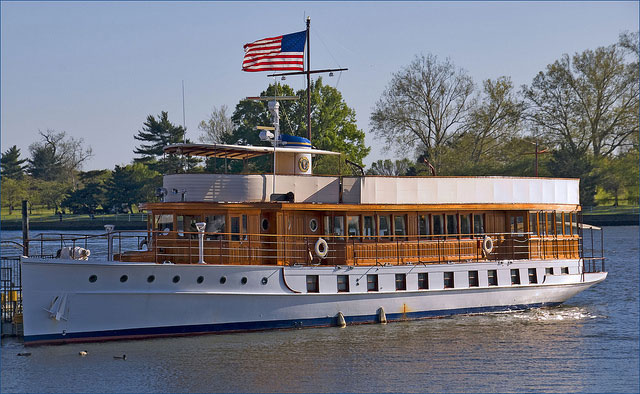
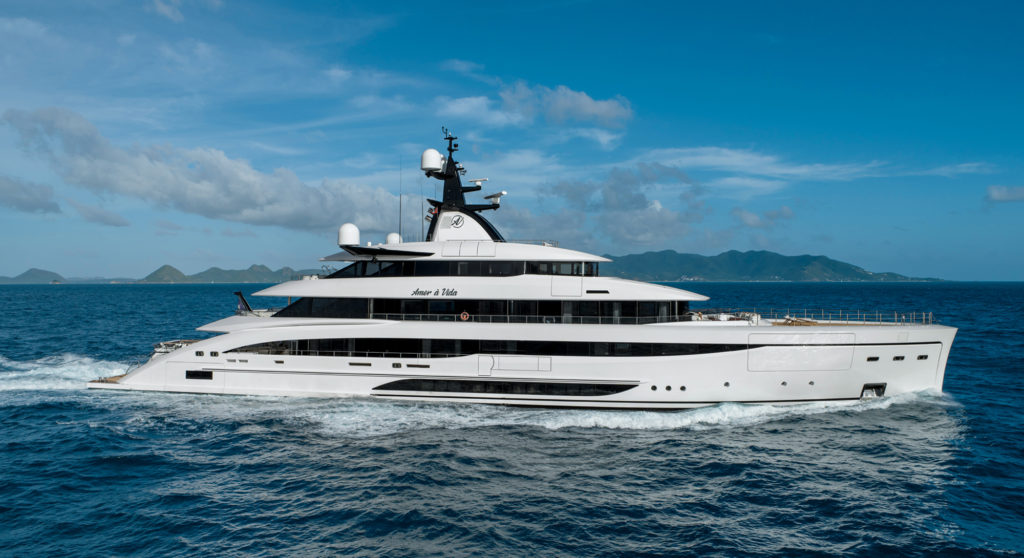
A superyacht prohibited from leaving London for three years will remain tied to the docks for the foreseeable future. The Supreme Court of the United Kingdom issued a ruling yesterday declaring the yacht Phi is lawfully detained.
The decision is the latest of several attempts by Sergei Naumenko, a Russian-born businessman and the ultimate beneficial owner of Phi, to free his yacht. Although the government hasn’t arrested the yacht nor stripped him of ownership, Naumenko cannot use Phi.
The UK government detained the yacht in relation to Russian sanctions in March 2022. It subsequently renewed the hold a few times. Notably, this became the first detention of a superyacht in UK waters resulting from the sanctions. Grant Shapps, the then-Transport Secretary, ordered the move. Without naming Naumenko, he cited the owner’s heritage, specifying that a Russian “owned, controlled, or operated” the yacht. Additionally, while Shapps admitted Naumenko wasn’t a sanctioned individual, his “close connections” to Russian President Vladimir Putin were another factor.

Naumenko and Dalston Projects Limited, the registered owner of the 192-footer (58.5-meter), jointly filed a few lawsuits prior to this latest appeal. Each time, they have challenged the sanctions regulation that Shapps used. It permits detaining a vessel owned, controlled, chartered, or operated by individuals connected to Russia. Furthermore, the lawsuits have indicated that Naumenko has no connection to Putin. The lawsuits also have stated that detainment restricts the rights to “peaceful enjoyment of possessions,” provided by the European Convention on Human Rights. Yet another point in the lawsuits, detention has prevented earning up to €650,000 a week in charter activity. Each time, however, the courts dismissed the claims, indicating that the Secretary of State has broad discretion.
The Supreme Court of the United Kingdom heard the most recent appeal in January. In the unanimous decision, the judges note that the government acknowledges justification is necessary for interfering with Dalston Projects’ rights. ”The issue between the parties is whether that interference is justified in light of the aims pursued by the sanctions or whether it is disproportionate and therefore unlawful,” they state.
To that end, the court found that the yacht Phi is lawfully detained for a few reasons. For instance, a clear economic link exists between the detention and pressure on Russia, the justices write. They point specifically to the charter income, adding that Naumenko likely would spend it in Russia. Even if he or his family spent the money elsewhere, “it nonetheless increases Mr. Naumenko’s disposable wealth and the resulting prestige he has within the circle of Russian society in which he moves,” they note. In turn, the economic impact likely has political ramifications, making Naumenko dissatisfied with the Russian government.

Regarding whether the Transport Secretary cited proper grounds for detention, the Supreme Court sided with the Court of Appeals. Naumenko’s connection with Russia was sufficient reason, the judges ruled—and was sufficient for him to challenge the decision.
Finally, Dalston Projects stated that it suffered the tort of conversion. Briefly, this is the taking or withholding of personal property without justification. According to the judges, “given the court’s finding that the detention of the Phi was lawful, the issue does not arise in this appeal.”
Although no further appeal is possible in the United Kingdom, one last legal option does remain elsewhere. Naumenko and his lawyers could request that the European Court of Human Rights hears the case.





Tansel
Lawfully detained :))) Yeah ..sure