

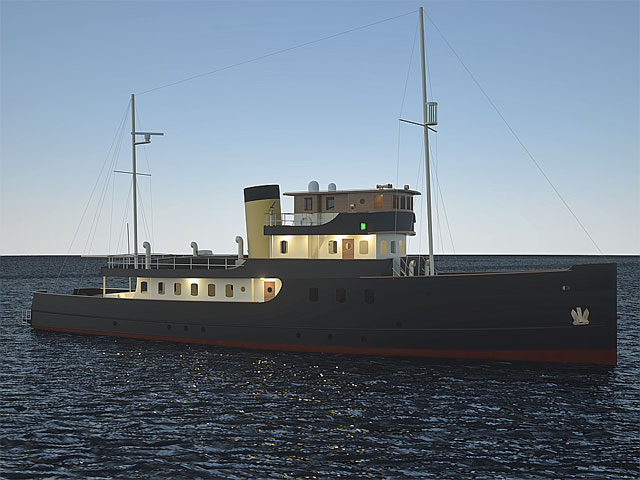
Scotland-based A. Mylne & Co., the world’s oldest naval-architecture firm, introduces the past to the present in this new megayacht design. Code-named PF-36, the yacht mixes Edwardian design elements with thoroughly modern mechanicals.
Founded in 1896, Mylne has contributed to the creation of numerous racing yachts, including Olympics competitors, as well as motoryachts and even ferries. Its experience dating back before the two world wars attracted the Swiss owner who commissioned PF-36. Mylne has been working on the design for the past 10 months and anticipates the owner settling on a shipyard by the end of the year.
Measuring 36 meters (118 feet), PF-36 certainly bears throwback styling. Note, too, that several individual elements echo classic yacht construction. The megayacht’s deckhouse is to be clad in teak, for example, and the anchor and other hardware are to be bronze, rather than stainless steel. Windows, winches, and other equipment are even being reclaimed from older vessels. This includes the Hastie & Co. steering wheel and pedestal. (Hastie dates back to 1870.) Furthermore, the steel hull’s shape dates to prewar times, mindful of how vessels of that era had lower horsepower. PF-36 will be powered by a single 600-hp Grenaa diesel engine. Grenaa, a Danish engine manufacturer, specializes in powerplants for heavy-duty applications. (Perhaps in honor of that, the owner of PF-36 wants to hear a hint of the engine’s running throughout the yacht.)
Even with the classic elements, Mylne is making sure that PF-36 is as contemporary as possible. Her specific Lloyds classification notation is +100A1 SSC Yacht Mono G6 Ice Class 1D. David Gray, Mylne’s director, explains that the owner wanted to explore polar regions just occasionally in summertime, so the yacht is being built to the lightest ice-specific requirements. However, he adds, “There was also a requirement to increase impact resistance to floating debris such as partly submerged containers, which are a known hazard to vessels navigating the world’s oceans – and this seemed a reasonable way to officially recognize this additional strengthening.”
PF36 will also be environmentally minded. Computational fluid-dynamics (CFD) testing reveals an anticipated fuel consumption that is carbon-footprint-friendly: 30 liters per hour at 10 knots, or just shy of 8 gph. PF-36 will also have a towing kite, akin to the one produced by the famed company SkySails, to harness wind power on long crossings. (At 10 knots under diesel power, PF-36 should see a 5,000-mile-plus range.) The kite sail will be installed on the foremast, which will further be fitted with a sliding crow’s nest. In addition, a 2-kW vertical-axis wind generator is to be installed atop the wheelhouse. Gray explains that it will deploy only when PF-36 is stationary and fold down when not in use.
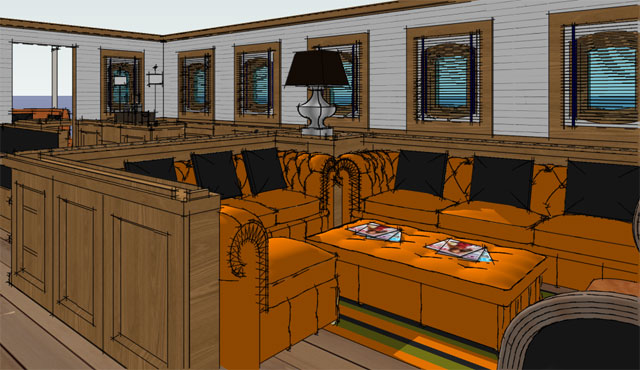
In keeping with her old-meets-new ideas, PF-36 will blend modern conveniences with Edwardian elements inside. Malcolm Duffin Design, a fellow Scottish firm, is enveloping the saloon, four staterooms, and other spaces with rich wood paneling. Lighter tones will be interspersed with this, to keep the feeling open. The final layout is still being determined, though under consideration is one with all staterooms below decks, featuring two master cabins and two guest cabins. Another idea: four guest staterooms below decks and a main-deck master suite. Regardless, beam will be 7.2 meters (about 24 feet).
Sure to be a hit with everyone: a whisky room, just forward of the captain’s cabin on the upper deck, stocked with some of Scotland’s finest bottles. Also sure to be a hit: 10 iPads kept in drawers throughout PF-36 that let guests do everything from access movies and music to check the dolphin cam in the bow. The iPads will additionally display navigation charts and keep the crew apprised of tank levels and systems’ statuses.
When on-the-water-fun is called for, three tenders will be at the owner’s and guests’ disposal. Two are custom-designed electric boats, measuring 5.5 meters (18 feet) each and made of aluminum. The third is an International 14 sailing dingy, stowed on the aft deck. (Of course, the crew will have a traditional diesel-powered boat for their use.)
The shipyards being considered to build PF-36 are in the UK and abroad. Stay tuned.


Leave a Reply