
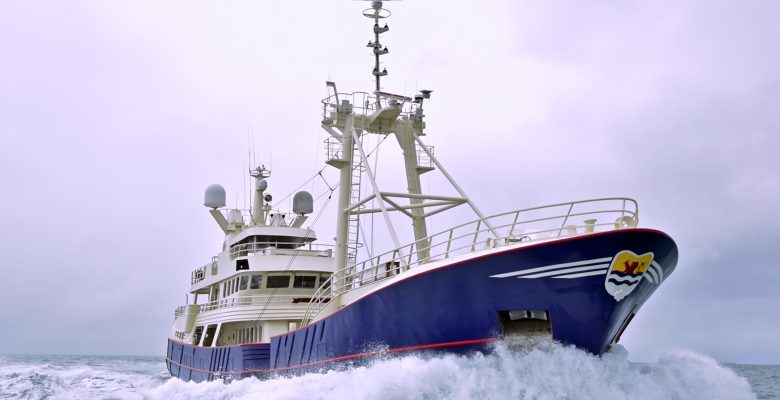
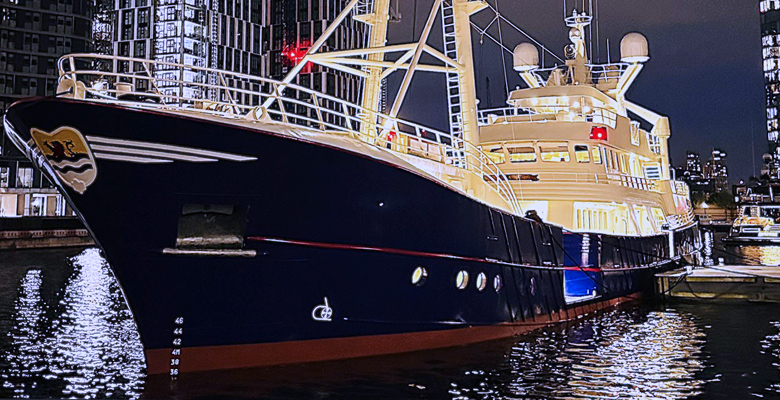
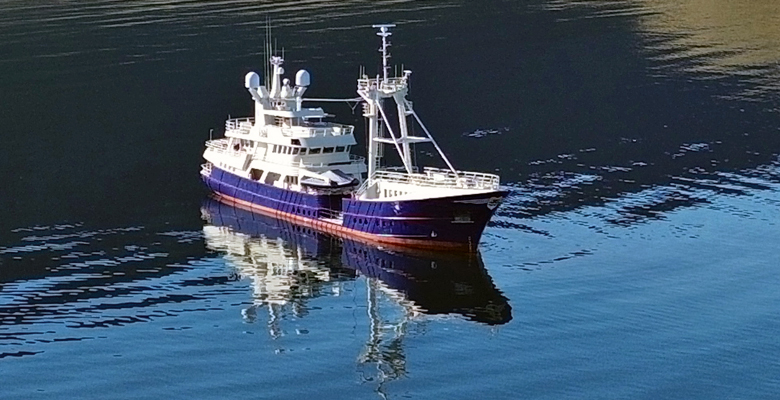
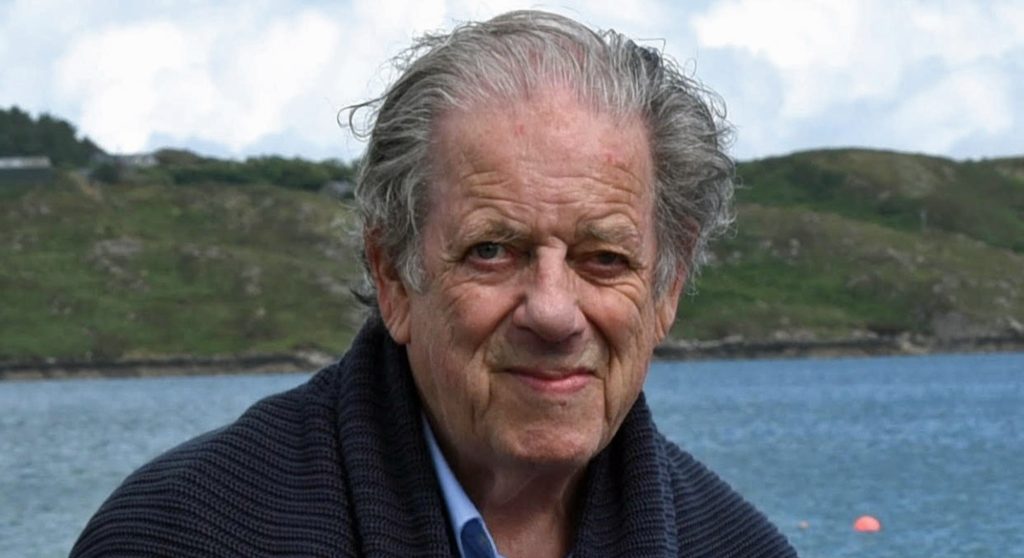
All yacht buyers and owners have a vision of what they want to do aboard. Erik Vonk does, too, but it may surprise you. You won’t find Vonk and his yacht Scintilla Maris (pronounced “skin-tilla mair-iss,” translating to “Spark of the Sea” from Latin) cruising the typical Caribbean and Mediterranean destinations. Instead, the 151-footer (46-meter), a former fishing trawler, is for seldom-visited regions. Onlookers might mistake her for her former purpose, and that’s fine with Vonk. Those rugged details are exactly what attracted him in the first place and what dictate her purpose as a different kind of pleasure yacht. Our editor, Diane M. Byrne, spoke with Vonk recently to learn more about what he terms her “soul” and why he’s comfortable with uncomfortable conditions.

Diane M. Byrne: You have a very different perspective on cruising compared to a lot of owners. Going back to when you bought your very first boat, what decision has mattered more to you than you ever expected it would?
Erik Vonk: I don’t know whether there’s been a surprise in there, but what I’ve always liked is the combination of ownership and using a vessel for a purpose, to go places. By ownership, I mean being involved with the development of it, with the maintenance, making the performance, the way it’s enjoyed, etc. So, it’s a full spectrum. I see so many people who own a boat and who have no clue and/or couldn’t care less. It’s their hotel or home away from home, and, you know, life is good. For me, it’s very different. For me, the boat has a soul, and I like to make sure that I have boats that have a soul that I like. There’s a level of identification, and that rings through in utilization.
Diane M. Byrne: I like that. It sounds like, in effect, you developed a philosophy about cruising. It’s not just the experience of cruising, right? It’s a whole vision, gut feeling, etc.
Erik Vonk: It is. When you use a boat, there’s varying degrees of what the expectations are of the journey. Is it the destination that you like, or do you also like the journey itself? There’s no good or bad way to use a boat. There are many owners who often don’t even join the boat when it travels from A to B. For me, that wouldn’t happen very often. I don’t think it has ever happened. If you enjoy both, then also the choices in what you do are influenced by what body of water you cross. Because taking the boat across the water somewhere is the journey. It’s okay if (conditions are) bad, because that’s the type of boat I have. And that’s the soul of the boat; I enjoy how the boat handles adverse circumstances. And all the reasons why not to go from A to B.
Diane M. Byrne: Scintilla Maris was never intended to be conventional. She certainly doesn’t look conventional, and that influences everything about her. What’s fascinating is the ultimate purpose. What has she allowed you to do that conventional cruising just can’t provide?
Erik Vonk: I’ve tried to preserve as much as possible of the original boat, because to me, that original vessel had the soul I can identify with, and which has developed over centuries, by generations and generations who have been fishing in the northeastern Atlantic. It’s the most unpleasant pieces of water in the world. This whole vessel is about survival, the ultimate in seaworthiness, being able to go out under any circumstances. Now, against that picture, we have traveled in the Nordic area and Faroe Islands. For most conventional yachts, you would have to wait for a weather window to quickly go there, because it’s going to be between unpleasant and dangerous. Then when you arrive, there are no traditional marinas or docks to hold faired hulls that can’t touch anything, and so forth. So, both the journey and the destinations are suitable for the soul of Scintilla Maris.

Diane M. Byrne: Is there another moment where the purpose of the yacht really became tangible?
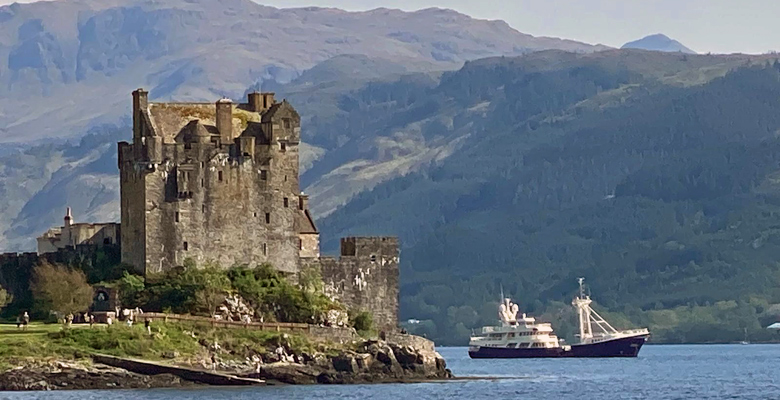
Erik Vonk: The first time that we went to places like I just mentioned. In 2024, we found ourselves in northern Scotland and had been in the Outer Hebrides, which are beautiful but rugged. Nobody goes there. One afternoon, looking on the ECDIS system, I realized what the relative proximity was of the Faroe Islands. Two days and nights of travel. At the spur of the moment, it was possible to say, “Let’s go, let’s do it.” We didn’t have to make preparations and ask how far, what’s the weather like, and so forth. That spur-of-the-moment decision could only have been taken on a vessel like this. As far as I know, the Faroe Islands have only one port, Forshavn. That’s a small commercial port, and for the rest, there’s nothing. So, long autonomy and the ability to dock in a commercial port were not issues. That is really magnificent.

Diane M. Byrne: Have those spur-of-the-moment decisions and opportunities been the most satisfying? Or is there a mix with ones that you planned well in advance?
Erik Vonk: Oh yeah, a number of places here along the U.S. East Coast, like Portland in Maine, had been long on a wish list. And Rhode Island, going to Boston, going to New York, etc. had been long on a list of, “wow, if that would ever be possible, then we’re going to do that.” When we finally arrived in Newport, Rhode Island, with the plan to be there a couple of days, we stayed for weeks, because we were finally in Newport! And so it’s both—both the spur of the moment as well as places considered to be desirable to go and visit. For me, it has to be both. The prospect of the journey as well as the destination need to be both there.
Diane M. Byrne: I would imagine that some of those destinations long on your wish list might have inspired more.
Erik Vonk: Absolutely. It opens the aperture further and further, and that is nice. The operative word is exploration. I think what we’re beginning to see is more and more people who have had longer-term yachting experiences, who develop more and more interest in that. They’ve seen the little runs from Marina A with a little town with Gucci stores to Marina B with a little town with Gucci stores. And they want to go to more exotic places that are harder to reach and where there are fewer boats. The whole purpose of Scintilla Maris from the get-go is not to go to those towns where the white yachts go. I think chances that you will see Scintilla Maris in the Med are slim to none.
What has further piqued interest in real exploration is the time that we’ve spent with scientists onboard, under auspices of Yachts for Science. We have been able to make the boat available for real research around mapping of biodiversity in the oceans. There are vast, vast portions of the oceans where that hasn’t been done, where we human beings do not know what lives there. By staying in touch with the Yachts for Science organization, we learned about the need for a research platform in the Iceland area, around the time that we were there. We ended up there for about 10 days or so, with a group of scientists taking underwater drones and doing a systemic mapping of areas on the northwestern part of Iceland. They found new species. That has been a phenomenally gratifying and eye-opening experience.
Scintilla Maris scintillamaris.com

More About the Yacht Scintilla Maris
LOA: 149’6” (45.6 meters)
Beam: 29’5” (9 meters)
Draft: not specified
Guests: 10 in 5 staterooms
Engines: hybrid propulsion (not specified)
Range: not specified
Builder: Damen Maaskant
Stylist: Damen Maaskant
Naval Architect: Damen Maaskant
Interior Designer: Vripack


Leave a Reply