
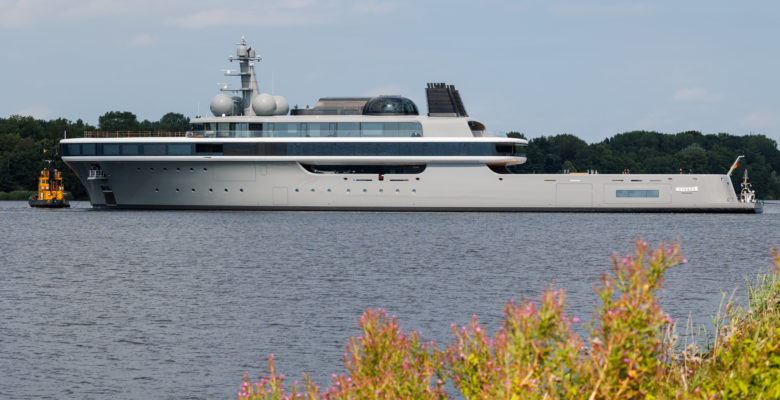
The world’s first fuel cell powered superyacht is nearly complete. The long-awaited superyacht Project Cosmos maneuvered out of a bay at Lürssen over the weekend.
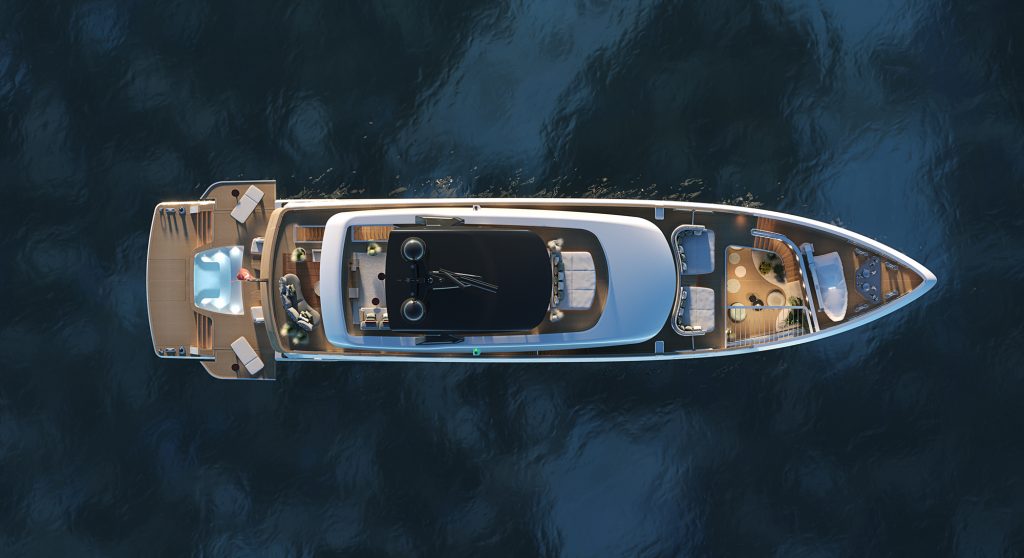
The launch lends the first looks at the complete profile. The 375-footer (114-meter) has a forward-shifted superstructure and a resulting elongated aft deck. Handrails peeking out along the open deck pair with a pool. A hot tub is also on this same deck area. Fully visible, meanwhile, a helipad is prominent on her bow. The enclosed areas aft of here have entirely glass bulwarks, including the wheelhouse (with adjoining wing stations). Notably, glass walls rim the entire deck beneath this, with the area inside being a full-beam observation lounge. Exterior styling and interior design are both by Marc Newson, an industrial designer. “Everything from the smallest detail to the silhouette—outside, inside, and everything in between—is our design,” he notes. “We have, therefore, been able to exploit and explore every creative possibility uninhibited. This liberating free rein afforded the project a joyful, organic evolution.“

Arguably one of the most noticeable organic features is the glass dome on the uppermost deck. This contains the owner’s study. Not just an aesthetic element, the dome is an engineering accomplishment, with large, thick panels of glass that necessitated rounding. Just outside, meanwhile, the owner has a private alfresco area, what the shipyard calls a sky terrace.
As for the propulsion system aboard the superyacht Project Cosmos, fuel cell technology has decades of history in other industries. In fact, fuel cells appear in a wide variety of applications, ranging from laptop computers to industrial power plants. Briefly, a fuel cell uses hydrogen or another non-fossil fuel source to produce electricity. It therefore has advantages, such as water being the only discharge when employing hydrogen. Additionally, fuel cells can operate at higher efficiencies than combustion engines. They further produce lower sound and vibration levels in comparison to combustion engines.
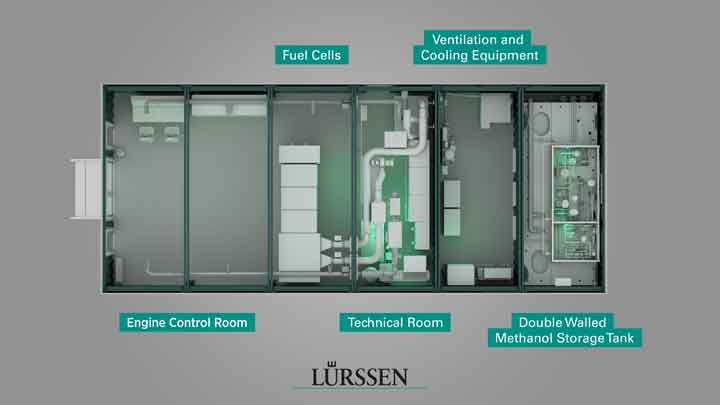
Prior to the technical launch of the yacht in March 2023, Lürssen provided insight into her fuel cell system. Project Cosmos relies upon hydrogen continuously reformed from methanol. Having participated in a German-government-sponsored research project for more than a decade, Lürssen determined methanol was more practical than elemental hydrogen. Firstly, methanol bunkering is available in several countries popular with yacht owners. This is largely due to the growth of fuel cells in commercial shipping. Secondly, liquid-methanol tanks are smaller than those for hydrogen. Hydrogen requires pressurization or liquefying, which further requires larger tanks and associated structural equipment. By contrast, liquid-methanol tanks can sit low in the megayacht’s double bottom.
Finally, the owner of Project Cosmos liked the cruising and lifestyle advantages of the propulsion option. Significantly, his yacht should be able to cover 1,000 nautical miles emission-free at low speeds. Once at a destination, all hotel loads and other onboard requirements can rely on the system’s 1 megawatt of power for up to 15 nights. World cruising is on the agenda.

“This is a rather special project to coincide with our 150th anniversary,” notes shipyard CEO Peter Lürssen. “While it is true that as a custom shipyard, no two yachts that leave our halls are ever the same, there are some that leave an indelible mark on our history. Cosmos is undoubtedly one of those yachts.”
Newson agrees. “Working with an immensely creative client has enabled rare opportunities to push the boundaries,” he says.
Lürssen lurssen.com
Marc Newson marc-newson.com

More About the Yacht Project Cosmos
LOA: 374’7” (114.2 meters)
Beam: not available
Draft: not available
Guests: not available
Engines: hydrogen fuel cells
Range: not available
Builder: Lürssen
Stylist: Marc Newson
Naval Architect: Lürssen
Interior Designer: Marc Newson



Leave a Reply