
Cars have fuel ratings, and home appliances have energy-efficiency ratings. Finally, an internationally agreed, science-based method for measuring and comparing the environmental performance of superyachts exists.
The International Organization for Standardization (ISO), which sets globally recognized benchmarks across nearly every industry, formally approved a new specification, ISO/TS 23099. It’s specifically for large yachts exceeding 98 feet (30 meters). In fact, it was a years-long effort that grew from the outcomes of the Yacht Environmental Transparency Index (YETI). An initiative of the Water Revolution Foundation, YETI paved the way for consistent and transparent environmental measurements in yachting. Robert van Tol, the convenor of the ISO working group producing the specification, explains that oftentimes, regulators apply the same rules to yachting as commercial shipping. So far, yachting isn’t subject to shipping’s tightening environmental rules. “ISO is the way to unite cross-industry experts and pro-actively work together on our own standards where international legislative guidance is absent or proves impractical to implement,” he says.
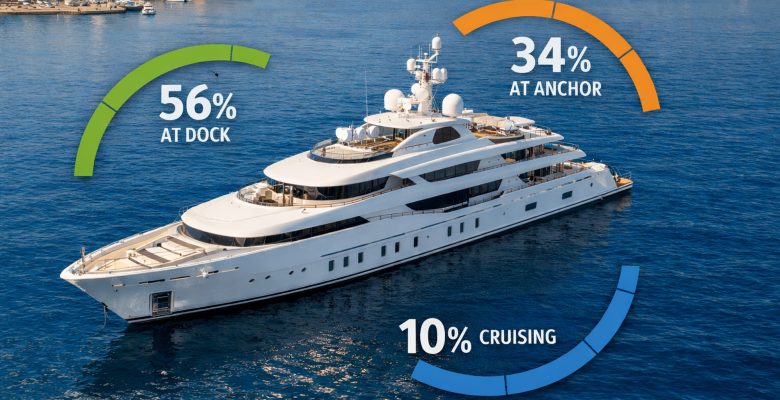
Importantly, the specification for the environmental performance of superyachts draws from data on how large private yachts truly operate. The working group conducted and compiled statistical research, coming up with a median operational profile. Specifically, it included cruising 10 percent of the time, sitting at anchor 34 percent, and docked 56 percent. According to Hanna Dąbrowska, Water Revolution Foundation’s technical director, this is “fundamentally different from that of commercial shipping.” In that industry, vessels are underway the majority of the time. A megayacht’s performance is calculated as a score, measured against other yachts within a similar gross-tonnage category.
Although environmental assessments usually focus on carbon-dioxide emissions, the ISO/TS 23099 specification goes further. It relies upon EcoPoints, which combine multiple factors like nitrogen oxides into a more comprehensive score. “This outcome enables users to fully understand the impact, but also to work out different scenarios to improve, both for new build and refit projects,” explains Awwal Idris, Water Revolution Foundation’s environmental expert.
More work lays ahead to apply the standard and “to make it more robust and widely adopted,” notes Lorenzo Pollicardo, the Superyacht Builders Association’s technical and environmental director. However, he says it confirms the proactive commitment shipyards have made to decarbonize. In the long run, “practical ways toward more environmentally driven yacht design, construction, and operation” will result.
Water Revolution Foundation waterrevolutionfoundation.org




Leave a Reply