

A yacht builder that earned accolades for an ultra-efficient megayacht is back in the spotlight. New Zealand Yachts is further in the hands of her founder, and leaning into multi-hull wave-piercers to capture interest.
New Zealand Yachts originated in 2001 in Whangarei, New Zealand. Its first project was the yacht Spirit (above and below), which launched in 2004. With design by Ken Freivokh, this 115-footer (35-meter) accommodated an owner’s party of 10. Many people took her for a power catamaran, a rarity then in the motoryacht market, let alone the superyacht sector. However, and importantly, Spirit was not actually a catamaran. Her twin hulls were wave-piercer designs. Briefly, a wave-piercer has an extended, tapered section at the bow, gradually getting wider as it flows back toward the middle of the yacht. It penetrates—essentially, pierces—the water, sitting atop it rather than within it. Traditional hulls, including catamaran hulls, submerge in the water and rise up (plane) as speed approaches efficiency. The benefits of a wave-piercer include a more comfortable ride, helping reduce pitching especially in rougher seas, along with better fuel economy.

Spirit attracted a lot of attention, especially media attention. The following year, New Zealand Yachts earned the Best Power Yacht (32–43 m) design award from the International Superyacht Society. She still cruises today, privately and as a charter yacht, under the same name and in the hands of just her third owners. As for New Zealand Yachts, it went on to perform an extensive, yearlong refit of Douce France, then the world’s largest sailing catamaran. The refit took place from 2007 to 2008.
The global financial crisis that followed, though, hit the shipyard, and other New Zealand-based builders, hard. It ceased constructing superyachts and focused on refit, but it wasn’t enough to sustain it. The company closed its doors by 2010.

Now, however, New Zealand Yachts’ founder, Allen Jones (above), has revived the brand in Auckland. (He had departed the company prior to its financial issues.) Each project will be entirely custom, yet still fitted with wave-piercer hulls. Jones is a strong believer in the design. “Spirit proved that design and innovation could co-exist with comfort and beauty,” he says. “This next evolution continues that legacy—delivering space, efficiency, and performance in harmony with the sea. Our goal has always been to craft yachts that feel alive in the water, not just on it.”
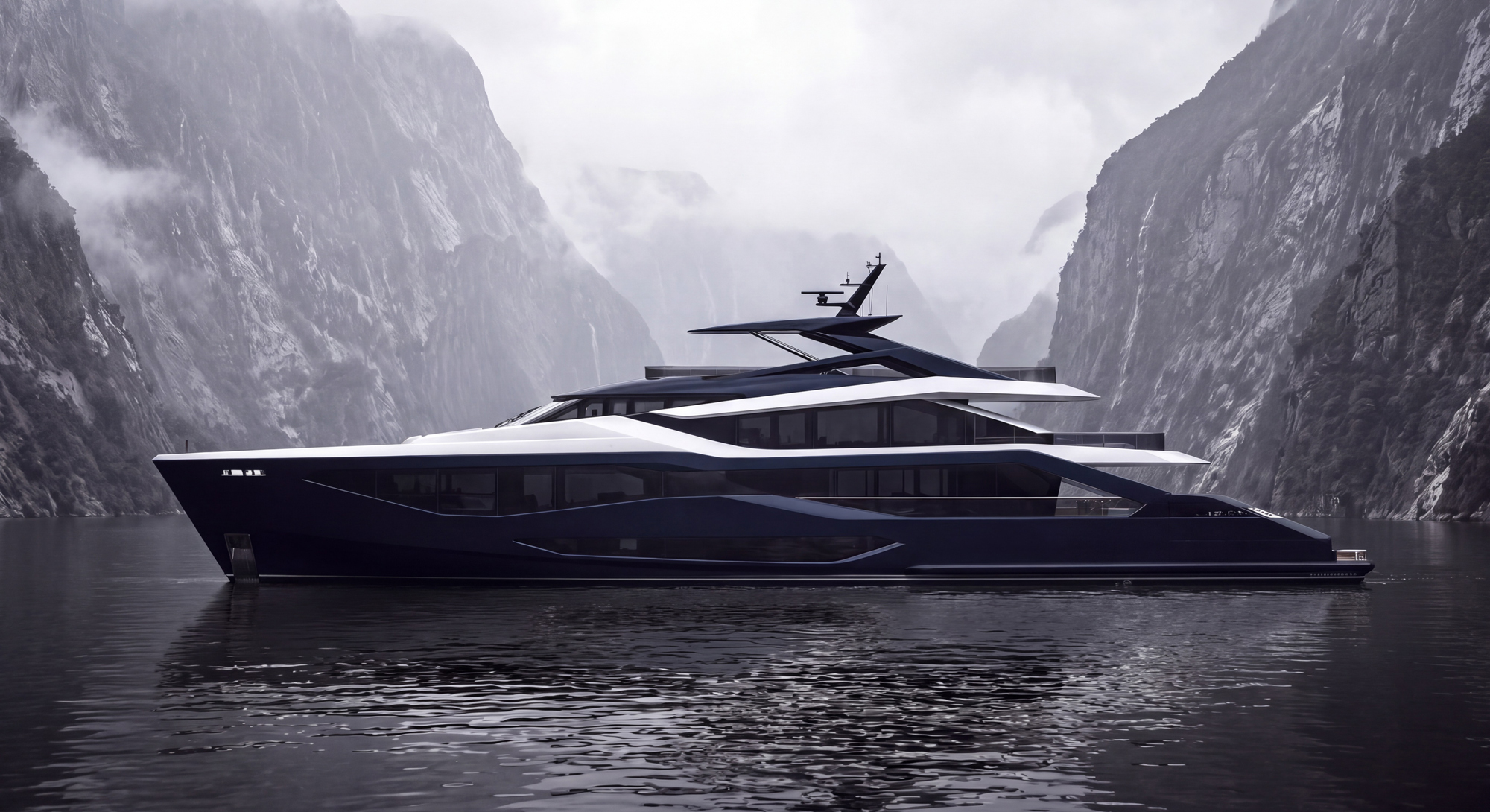
Specifically, each New Zealand Yachts project features what the builder calls Wavepiercer Transition-Tubes hulls, with naval architecture from Incat Crowther. According to the shipyard, they leverage the same benefits that Spirit offered. Those further included better speed and a small wake. Buyers can choose between MTU and Caterpillar engines, additionally with pod drives. Pods have earned renown for performance and keeping draft down. Another option: methanol/hydrogen fuel cells for the 164-foot (50-meter) Wavepiercer, pairing with batteries for hotel loads at anchor.

Another big difference compared to catamarans, the alfresco areas and most interior spaces sit well above the water, providing ample ways to emphasize the sense of spaciousness. For instance, guest staterooms can sit on the main deck—full beam as well. Watertoys and tenders can stow in the hulls, or between them. Of course, charter-friendly features like gyms and pools are possible, as are configurations that protect privacy. The build team is collaborating with Ken Freivokh for interiors once again.
Jones and other shipyard representatives are attending this week’s Fort Lauderdale International Boat Show and available for meetings.
New Zealand Yachts newzealandyachts.com




Leave a Reply