

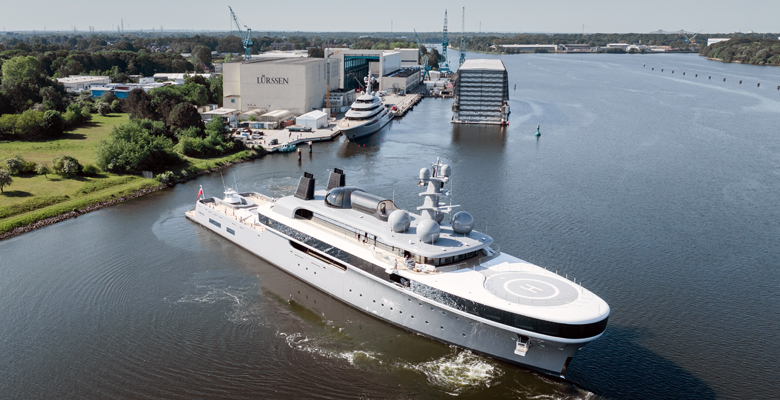
With world cruising in her sights, including polar journeys, the highly anticipated Lürssen yacht Nausicaä is on her maiden voyage. There’s nothing conventional about the formerly code-named Project Cosmos, either, from her operations to her looks.
Firstly, Nausicaä, which shares her name with a Japanese anime film about adapting to and coexisting with the environment, has provisions for a methanol fuel cell. Briefly, a fuel cell uses a non-fossil fuel source to produce electricity, with no harmful emissions. Additionally, fuel cells can operate at higher efficiencies than combustion engines, plus produce lower sound and vibration levels. Eventually, the yacht Nausicaä will rely upon hydrogen continuously reformed from methanol. Having participated in a German-government-sponsored research project for more than a decade, Lürssen determined methanol was more practical than elemental hydrogen. Among the reasons, methanol bunkering is widely available in countries popular with yacht owners. Liquid-methanol tanks are also smaller than hydrogen tanks. For now, the megayacht is relying on diesel-electric propulsion, with a battery bank capable of running all hotel loads at anchor for more than 15 days straight.

Besides embracing alternative propulsion, the owner embraced alternative design. In fact, he didn’t work with any of the superyacht design studios. Instead, he approached Marc Newson, a famed industrial designer. The bold signature of Newson is apparent on every aspect of the styling and interior: soft, organic silhouettes along with aerodynamic and ergonomic geometries. Newson also has earned renown for pushing innovation in materials, and the yacht Nausicaä continues that tradition.
For instance, one of the most notable physical features is a glass dome on the uppermost deck. Lürssen calls it the SkyDome, and each of its seven panes measures nearly 10 by 9 feet (3,000 x 2,800 mm). Additionally, they’re 2.4 inches (62 mm) thick. Altogether, they weigh about 2,315 pounds (1,050 kilograms). To get the curves that Newsom wanted, the subcontractor used gravity bending. The process involves heating the glass to a temperature so intense that it becomes incredibly pliable and falls naturally into a mold. Once it cools, it retains the complex shapes. To ensure it would work, the company manufactured and tested several full-size mockups.

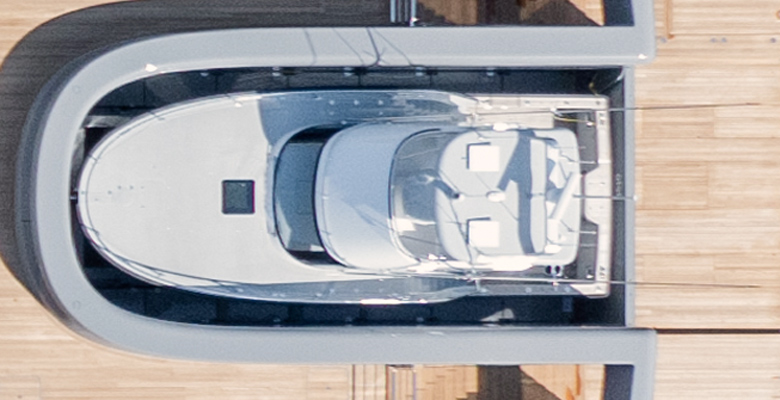
Yet another good example aboard the yacht Nausicaä is the plethora of rounded and louvered exterior features. Not only is hardly a flat surface anywhere, but the curves are all steel. Carbon composite or fiberglass more readily adapt to these shapes, but continuity was important to Newsom and the owner. Lürssen’s craftspeople had their hands full in designing and crafting cylindrical shapes for everything from individual exterior doors to the exhaust masts and to the aft deck—especially the bay housing Nausicaä’s 41-foot (12.5-meter) sportfishing tender fully aft. “It is extremely challenging for a design project, of any description, to literally delivery on the vision conceived and presented at concept stage,” Newsom shares. “Here, I am very proud to say that every detail, at every scale, has been realized at the most coherent level.”
Even in spaces where traditional boundaries remain, creativity applies. The upper deck is a good example, with glass enveloping it to provide panoramic views. The views are particularly special from inside the 62-foot-wide (19-meter-wide) observation lounge, beneath the certified helipad. Elsewhere along the deck, though, doors and bulwarks couldn’t be glass. So, they preserve the illusion via reflective surfaces and tint. Furthermore, the teak-lined bay in which the sportfishing tender stows doesn’t need to remain empty when the boat is out. The yacht Nausicaä transforms it into a covered lounge. The tracks that the sledge relies upon create overhead shelter, while a flat hydraulic beam closes off the rest.
With an aft-deck swimming pool deep enough for diving, the break with convention aboard the yacht Nausicaä continues inside. A two-level atrium replaces the main saloon, for example. The upper level includes a circular balcony overlooking an art gallery on the lower level, where a sizable sculpture commands attention. The owner has a variety of treasured pieces on display throughout the remaining lower-level space. As for the rest of the upper atrium, it’s an entertainment and reception space. A sushi bar, space for table tennis, and inlaid settees greet guests, all once again bearing Newsom’s handiwork.
Topping everything off, quite literally, is a 603-square-foot (56-square-meter) owner’s office. It’s within the SkyDome and enjoys soaring ceiling heights of 10 feet (3.15 meters). When the owner wants a bit of shade, he can draw elaborate bronze shutters on a circular track. But, if he’d rather step out and enjoy the sights, he has a private terrace, too.

Reflecting on the delivery, Peter Lürssen, the yard’s CEO, says he feels “a profound connection to my great-grandfather, Friedrich Lürssen, who built the world’s first motorboat in 1886.” Gottlieb Daimler, the inventor of a 1.5-hp internal combustion engine, commissioned a small wooden boat, REMS, from the yard to test it. It led to a long working relationship between the two. Peter Lürssen adds, “Nausicaä has truly broken new ground, just as the 6-meter REMS did 140 years ago.”
Lürssen lurssen.com
Marc Newson marc-newson.com
More About the Yacht Nausicaä
LOA: 374’8” (114.2 meters)
Beam: 59’1” (18 meters)
Draft: 15’5” (4.7 meters)
Guests: not available
Engines: 5/diesel engines w/2-mW battery bank
Range: not available
Builder: Lürssen
Stylist: Marc Newsom
Naval Architect: Lürssen
Interior Designer: Marc Newsom




Leave a Reply