
Editor’s note: This is the third article in a series by Dominique Gruber. His decades of experience advising UHNWIs in managing yachts, estates, jets, and art reveal that most family offices currently lack proper structuring to oversee them. Too often, fragmented or insufficient governance results, and in a peripheral role. An independent yacht owner’s representative therefore lends the necessary foundation. This professional ensures oversight matters as much as design and comfort. In this final article of the series, Gruber outlines the importance of redefining a superyacht from a status symbol. Instead, family offices should view a yacht as a well-managed asset within a long-term legacy and wealth-transfer strategy. Reframing a yacht as a strategic vs. discretionary asset makes the yacht owner’s representative a stronger partner, too.
For decades, assets such as yachts, private aircraft, estates, and art collections have fallen under broad labels. They’re lifestyle assets, for instance, even passion assets or life-management assets. These terms are convenient, but misleading. They suggest discretion and consumption rather than strategy, structure, and capital allocation. Yet, a modern yacht is an illiquid, capital-intensive, operationally complex asset. It involves multi-year investment cycles, regulatory exposure, and significant ongoing costs. In many respects, it’s closer to a private-equity investment than to a discretionary purchase. The issue, then, is not simply governance. It is classification—specifically, financial classification.

A Necessary Reframing
Traditional financial frameworks do not fully capture this category. Chartered-financial analyst literature defines private equity as investments in private companies, with structure and active management. By contrast, assets such as yachts or jets are often treated as consumption or peripheral wealth. In practice, though, family offices recognize their importance and financial impact. They refer to them as real assets, non-financial wealth, or lifestyle assets. By not integrating them into a structured investment logic, they’re exposing a gap between how they describe a yacht and how the yacht actually operates.
It may therefore be useful to introduce a more precise framework: non-financial private equity. The term isn’t part of standard financial taxonomy, but it reflects the operational realities. As mentioned above, superyachts are illiquid and capital-intensive. They’re additionally strategic within a patrimonial context, and dependent on active management. In other words, they share key characteristics with private equity, without being financial securities.

The Scale of the Shift
This reclassification reflects a broader structural evolution. According to Deloitte, in 2025 more than 8,000 family offices were around the world, up from around 6,100 in 2019. Furthermore, Deloitte projected a global total upwards of 10,700 by 2030. Consider, too, that the global superyacht fleet is about 5,600, according to a recent study by Deloitte and Vrije Universiteit Amsterdam. It’s quadrupled over the past 30 years. The same study reveals that just one superyacht contributes about $10.5 million (€9 million) annually to the economy during its lifetime. These are not figures of peripheral assets.
This dual expansion reflects the rise of sophisticated private capital structures alongside the accumulation of complex non-financial assets. Notably, while scale has increased, classification—and therefore governance—has not evolved at the same pace. It’s crucial for family offices and banks to have experienced professionals address this. The individuals should understand both yachting and financial structuring, and defend the yacht owner’s interests without compromise.

From Perception to Governance
Classification drives behavior. When people perceive an asset is discretionary, for example, they manage it informally. Similarly, when they believe it’s strategic, they govern it. Redefining a superyacht as non-financial private equity leads to a different approach. That approach includes structured decision-making when building or buying a yacht. Intended use, design, and construction align. Lifecycle cost discipline, operational oversight, and integration within the broader family office strategy all occur as well.
This shift transcends mindset alone, becoming an economic move. Just as with private companies, real estate, and direct investments, yachts benefit from structured governance. It improves outcomes through cost control, risk mitigation, and value preservation. While those results can vary in yachting, experienced practitioners consistently observe that early-stage discipline prevents significant inefficiencies. It’s particularly true during construction and initial operations. Without it, value erosion gradually occurs due to misaligned specifications, overstated operating models, and incoherent lifecycle decisions.
The Role of Structured Stewardship
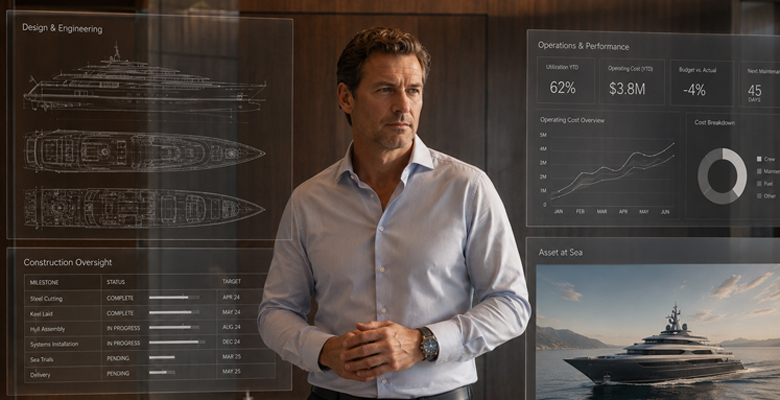
Within this framework, the role of the yacht owner’s representative as a strategic steward becomes clear. He or she ensures continuity among vision, execution, and long-term management, always defending the owner’s interests. Essentially, the owner’s representative does just what investment directors, operating partners, or strategic advisors do. The only difference is, he or she fills the gap of structured oversight for the yacht within the family office.
The yacht industry is undergoing clarification—you might say an evolution. What was once perceived as a lifestyle extension is increasingly recognized as a complex asset requiring governance and alignment. The decision to acquire a yacht remains fundamentally emotional, driven by the desire to create experiences. Proper governance by the yacht owner’s representative protects and enhances it. At the same time, the owner’s representative removes complexity, taking on the lifecycle and strategic burden, allowing the owner to step back from an asset too often misunderstood or insufficiently managed. Ultimately, he or she restores what the owner intended to enjoy and what the yacht intended to deliver: clarity, continuity, and peace of mind.





Leave a Reply