
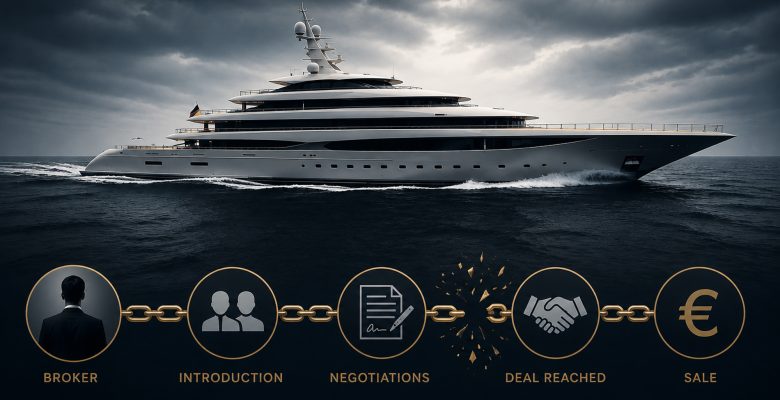
August may be a slow news cycle in most industries, but yacht disputes don’t wait for quiet months. The conversation around the Cecil Wright & Partners claim against buyer Nik Storonsky, the owner of the yacht Nixie (below), shows how quickly public opinion forms when a superyacht sale commission becomes headline news. What stands out most is not the amount of the claimed commission or the reported €350-million cost of the superyacht. Instead, it’s the lack of understanding about what a superyacht broker does, who typically pays commissions, and what earning them really means. If you’re in yacht sales or transactions, or just want to know how deals get done, this episode of The Yacht Law Podcast is a reminder that facts, documents, and timelines matter more than hot takes.
The central argument of the lawsuit is “effective cause,” a.k.a. procuring cause in U.S. law. Regardless of wording, it means who actually causes the sale to happen. A yacht broker can source options, for example, coordinate introductions, and keep negotiations moving toward a price. Importantly, under the law, a mere introduction is not always enough. However, exclusion can change everything. If a buyer and seller start direct negotiations right after the broker brings them together, a court may consider that as evidence the broker’s efforts were the reason the deal concluded. In fact, in yacht brokerage, that line between fair dealing and cutting out the intermediary is where significant disputes ignite. We place the current dispute in the context of recent yacht brokerage cases that turned on effective cause.

This episode of The Yacht Law Podcast also clears up core mechanics of superyacht broker commissions. While industry standards are different for new builds versus brokerage buys, nearly everything is negotiable under written contracts. This is why brokerage services agreements and clear engagement terms are so important. The discussion highlights why uncertainty can open the door to litigation. Informal emails, for instance, unclear authority inside a buyer’s team, and the presence or absence of documents all have impact. Ultimately, the “what exactly was sold” question can become part of the commission fight.
Time is yet another major factor. Although Cecil Wright & Partners’ action appears timely, generally speaking, courts look at whether brokers keep the proverbial snowball rolling, or momentum stops and someone else gives it the decisive push. There’s plenty of legal precedent, both with superyacht brokers and other sales-driven situations, which our podcast hosts—Megayacht News’ editor Diane M. Byrne and maritime lawyer Michael Moore—examine. The points are crucial for yacht buyers, sellers, and brokers to understand. Otherwise, parties end up arguing over ambiguity, and courts supply the definitive decision.
Finally, the episode explores a legal argument related to effective cause: tortious interference. It can enter the picture if a seller knowingly helps a buyer bypass an existing broker relationship. Therefore, brokers and their lawyers frame the seller’s conduct as intentional interference with a business relationship.
The takeaway is not a prediction, but a roadmap. Keep records, confirm authority, put terms in writing, and assume that the cleanest “industry standard” argument is the one you can prove with documents. Listen and share this episode with a colleague, and subscribe to The Yacht Law Podcast for free. It’s on Apple Podcasts, Spotify, Amazon Music, or your favorite streaming platform.






Leave a Reply