
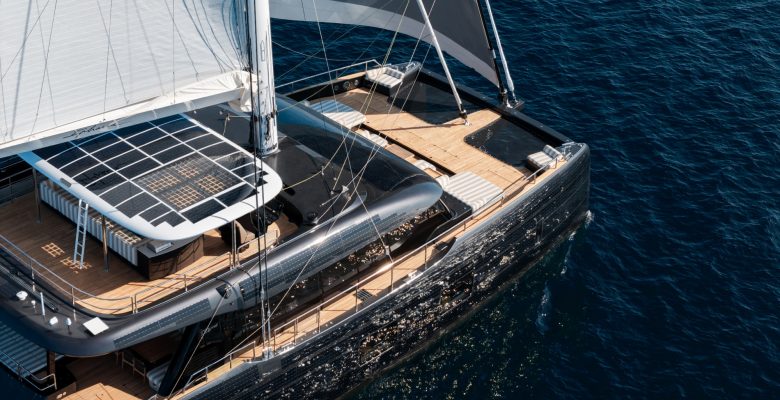
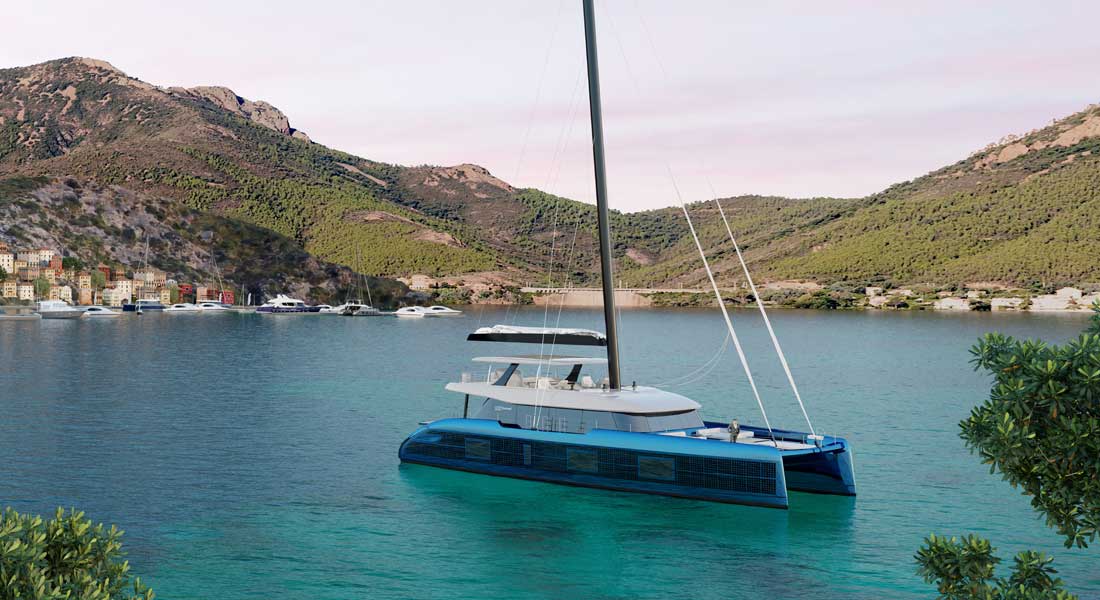
Family cruising and student voyages shaped the brief for Ipharra, the first Sunreef 100 Eco yacht. Recently making her public debut at the Monaco Yacht Show, the sailing catamaran pairs electric propulsion and integrated solar panels with an owner’s longstanding commitment to education at sea.
The owner previously commissioned the Sunreef 102 Double Deck Ipharra, which launched in 2010. In fact, she was the first superyacht from the shipyard. Sixteen years later, her successor is supporting private family cruises, yet also continues a purpose extending beyond them. The owner has a relationship with Le Rosey, a Swiss boarding school, and intends to welcome students onboard for educational opportunities. In both the Mediterranean and Caribbean, the 94-foot (28.65-meter) Ipharra will support studies ranging from geography and history to marine biology and ocean conservation. The earlier Ipharra similarly hosted learning experiences, including sailing maneuvers and plotting routes.
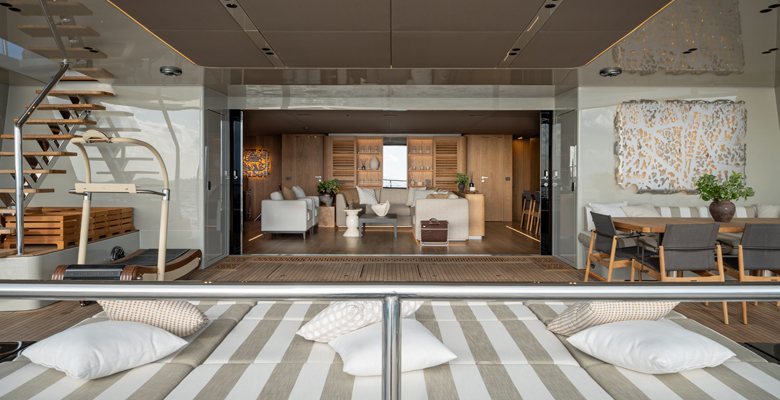
The owner collaborated with Sunreef’s design team to ensure these dual roles were possible without needing to rearrange entire rooms. The open saloon is the perfect example. There’s plenty of space for gathering and learning, for instance, alongside deep seating and a dining table for 10. Additionally, a projector screen retracts into the overhead. Oak cabinetry, darker oak flooring, and light upholstery establish a warm, nautical backdrop without competing with the lessons—or views.
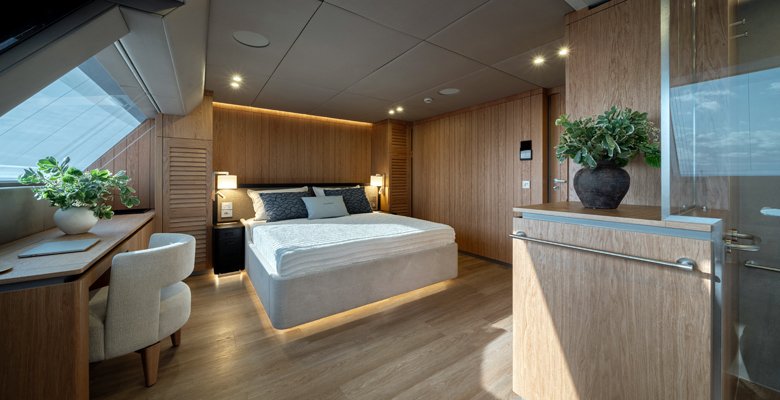
In support of the family’s travels and learning voyages, meanwhile, five staterooms accommodate guests. A single cabin sits adjacent to the main-deck owner’s suite, especially for a young one. As you might expect, the master suite has private access to the foredeck relaxation area. The remaining four staterooms are in the two hulls, each with either twin or double beds.
The arrangement close to the water serves equally practical purposes. A garage holds two sailing dinghies, for example, still with room for PWCs when wanted. The aft platform between the hulls can carry tenders and water toys when it’s in an elevated position. Lowered, meanwhile, it links the hulls near the water’s surface. It additionally allows guests to step onto fold-down side terraces, expanding the space for swimming and watersports.
Renewable energy is as much a part of the cruising advantage as it is the students’ onboard lessons, too. More than 2,690 square feet (250 square meters) of Sunreef’s Solar Skin—proprietary photovoltaic panels—integrate into the hulls and superstructure. According to the shipyard, it has a peak output of 49 kilowatts, enough to power Ipharra’s hotel loads. For more environmentally minded repositioning, a 770-kWh battery bank unites with twin 360-kW electric motors.
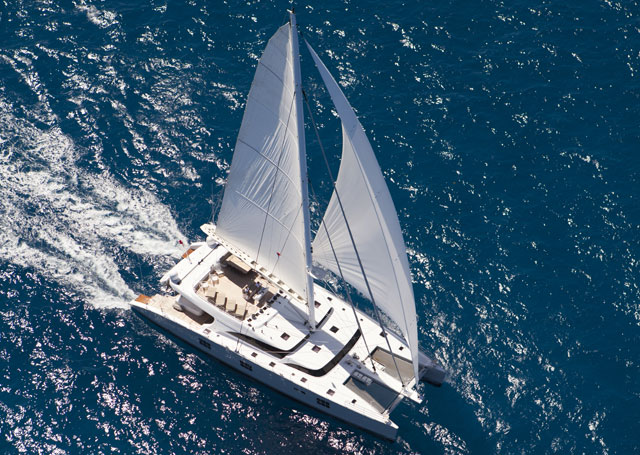
Make no mistake, though, the owner intends to use Ipharra as a true sailing yacht. Sunreef reports speeds of 8 to 10 knots in winds of 15 to 20 knots. A carbon mast supports the sail plan, giving students opportunities to explore both wind power and the decisions involved in managing energy aboard a yacht.
“Ipharra embodies a mission that transcends the traditional role of a yacht,” says Francis Lapp, Sunreef founder and CEO. For her owner, the new delivery carries that mission into another generation of cruising—and another generation of students.
Sunreef Yachts sunreef-yachts.com

More About the Yacht Ipharra
LOA: 94’0” (28.65 meters)
Beam: 42’0” (12.8 meters)
Draft: 8’2” (2.5 meters)
Guests: 12 in 6 staterooms
Rig: cutter
Upwind sail area: 5,167 square feet (480 square meters)
Builder: Sunreef Yachts
Stylist: Sunreef Yachts
Naval Architect: Sunreef Yachts
Interior Designer: Sunreef Yachts




Leave a Reply