
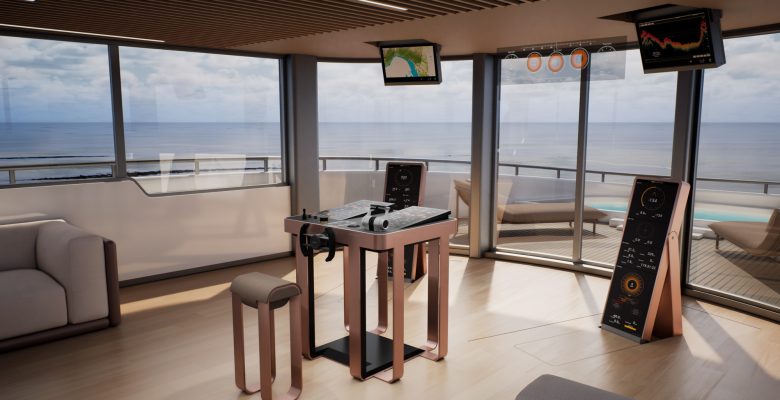
Designers and shipyards are regularly rethinking deck layouts to give owners and guests more usable and flexible space. The wheelhouse, though, has largely remained the same for decades. Rolls-Royce Power Systems’ Point Break bridge design doesn’t just reimagine the possibilities. It radically transforms the wheelhouse into part of the relaxation and entertainment area without impacting the captain’s needs or safety.
The Point Break bridge design is the latest version of the MTU NautIQ Bridge, an integrated wheelhouse configuration for semi-custom superyachts around 164 feet (50 meters). Owned by Rolls-Royce Power Systems, MTU engines and the NautiQ Bridge are on several Sanlorenzo yachts, for instance, as well as Mangustas and other builder’s projects. The NautiQ Bridge already rethinks tradition by incorporating heads-up display data, but Point Break is a major evolution of helm architecture.

The reason is pretty simple. “Our customers are looking for ways to maximize onboard space without compromising safety or operational readiness,” explains Christian Paolini, Rolls-Royce Power Systems’ managing director for bridge and automation systems in Italy. The wheelhouse, he continues, is “one of the yacht’s most space-intensive operational areas.” The team wanted to recapture some of the floorspace for owners and guests, yet boost navigation needs.
The Point Break bridge design, unveiled at the Monaco Yacht Show last month, does so in a few ways. Firstly, the navigation displays can retract when the yacht is at anchor or docked. The helm can slide into a stylish console-turned-furniture, opening up floorspace. When it’s time to get underway, the captain or crew can put it into the proper position again and begin using it immediately.
For those operations, the design is quite practical—and makes captains’ and crew’s jobs easier. The displays are vertical, not horizontal, making more efficient use of space. In fact, this follows Human Machine Interface (HMI) design practices, which prioritize at-a-glance situational awareness and simplified layouts to prevent confusion. Additionally, like the previous versions of the MTU NautiQ Bridge, heads-up display data is incorporated. The design was created in anticipation of upcoming AI-supported documentation-management systems and other digital solutions, too.
Although it’s still in the concept stage, the Point Break bridge design could become reality in the coming years.
Monaco Yacht Show monacoyachtshow.com
Rolls-Royce Power Systems rolls-royce.com





Leave a Reply